818 comments
That being said, many countries consider it a national security issue not to be held hostage to foreign oil.
Are you serious when putting France in this list? Nuclear is such a cash cow here that EDF manage to make profits even while being forced by the regulator to sell a big fraction of its nuclear capacity below the operating cost and buying it back to them at market price! (We're talking about a multi-billon subsidies scheme, look for ARENH).
And that is despite (rather legitimate IMHO) regulatory constraints that have no equivalent in any other industry.
https://m.youtube.com/watch?v=cbeJIwF1pVY
Here's an Illinois professor going through the economics compared to a gas plant.
Nuclear power can become dramatically cheaper than other energy sources in the long run.
If energy prices are too high, industry suffers. If you let the price rise, maybe China just eats your lunch.
What's the option value vs risk of gas price rises? Gas sets the marginal price of electricity in Italy today for 60% of the year [1]
[1] https://www.terna.it/DesktopModules/AdactoBackend/API/direct... "However, the electricity system remains significantly exposed to gas price volatility, which in 2024 determined electricity prices for more than 60% of the hours."
> That being said, many countries consider it a national security issue not to be held hostage to foreign oil.
Spot on. That, plus... peak oil.
If a power generation system costs more to operate than the value of power we get out of it, it's probably not very useful. I think that's what we're talking about here.
Electricity is super-duper easy to measure the individual benefits of, so profit is a really simple and easy way to measure the overall effective economic benefit. It's not perfect though - there are external costs to consider which aren't paid for directly, but we have lots of experience with that across all sorts of industries and usually solve for that via taxes and regulation, which become part of the profit equation.
There are good reasons to choose more expensive things, but "nuclear sounds cool" is not a good reason. There must be some sort of rationale and benefit beyond that.
You see this pattern a lot in academia. Education is a great example. We know what works when, for example, it comes to teaching literacy. It's phonics. But over the past few decades we had a fad with "sight words". The evidence has come in that this has been a disaster. So why did it happen? Because nobody is going to get prestige in their education PhD by pushing an existing idea. They're incentivized to reinvent that wheel to shape themselves as an expert in the new wave.
That's exactly how SMR came about. It takes the idea of scaling by going small and repeating what you're doing rather than doing what you actually need to do and that is to standardize large designs. Larger reactors are just more efficient and that's physics.
I bet I could come back to HN in 10 years and SMR will still be exactly nowhere yet people will still be promising a bright future for it.
If safe is your metric, nuclear power kills fewer people than roof top solar.
The referendum that made nuclear energy illegal in Italy was held right after the accident of Chernobyl; people voted with their gut, not with their mind.
Curiously enough, some Italian town signs still have a small sub-sign reading "denuclearized municipality" (example: https://live.staticflickr.com/1421/712461235_e46a2c7db5_z.jp... )
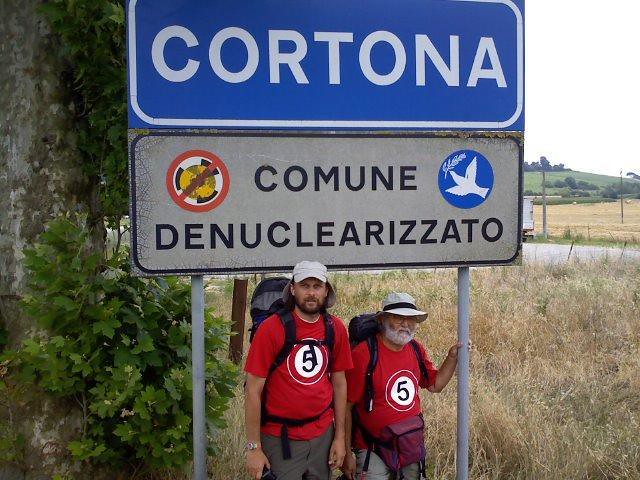
Since all plants in Italy are closed since the 90s won’t it take decades and billions of tax euros to get them back operational again?
[1] https://www.sciencedirect.com/science/article/abs/pii/S03605...
[2] https://en.wikipedia.org/wiki/Cost_of_electricity_by_source#...
https://maps.eu-risk.eucentre.it/map/european-seismic-risk-i...
Sardinia?
Is the Italian coastline at high risk of tsunamis as well?
I would say near Pisa, on the Arno River.
Judging from the map, Piedmont, Liguria, Trentino, Tuscany and Basilicata have good sites.
https://www.nytimes.com/2026/09/20/world/asia/philippines-ba...
Italy lost WWII, and became a de facto protectorate/colony of the US. I wouldn't be surprised if behind the nuclear referendum in the 80s there way to gentle hand of US services.
Belgium stops decommissioning nuclear power plants: https://news.ycombinator.com/item?id=47961319
Canada plans 'nuclear renaissance' with up to 10 reactors built by 2040: https://news.ycombinator.com/item?id=48634585
Its important to remember that nuclear needs water and is not immune to climate change. France and Switzerland shut down nuclear power plants amid scorching heatwave: https://www.euronews.com/2025/07/02/france-and-switzerland-s...
And maybe unknown future costs. Government awards $45B to company treating over 50M gallons of leaking radioactive waste: 'One of our nation's most important environmental challenges': https://www.thecooldown.com/green-business/hanford-nuclear-s...
Admiral Rickover's 'Paper Reactor' memo: https://whatisnuclear.com/rickover.html
Spain's reactors were fine. Regulations of cooling water discharge temperature are what are limiting the reactor output. Adding cooling towers to the power stations leads to a poorer condenser vacuum than river water, reducing electrical output by a few percent, but still a possibility. Whether it is economically worthwhile to retrofit cooling towers is another question.
I’m particularly interested in how they plan to finance reactors in a grid dominated by solar. I wouldn’t be surprised if they legally allow the building of new reactors but then fail to find investors. But perhaps they plan on using them as some sort of strategic assets and will just run them at a loss?
Solar is 15% - a lot but not yet dominated. Solar works at day and demand is also highest during the day so solar should not be an enemy of nuclear.
This is what the OP means - they make no economic sense on most modern grids.
Nuclear has no real cons other than time/cost of deployment, and it should be a no brainer for a place like Europe without significant energy resources. Once the power plant is built, it provides 50+ years of nearly free energy. It's that or buying gas from Russia.
The uranium needs to be regularly replaced. Europe currently imports virtually all of the uranium used by its nuclear power plants. While Europe has some decommissioned uranium mines, they would have to be reopened, but the known deposits are estimated to cover less than the 50 years you cite, at current levels of nuclear production (much less when expanding production).
So if this is about energy independence rather than cost, I’m not sure that it would be such a great win.
That's not true. It's extremely expensive to operate for one, so expensive in fact that nobody in the private sector wants to do it without having nation states basically guarantee profits for the lifetime of the plant or accept all liability. Which in several countries means that he operator is the nation state. Like in France.
The profits are guaranteed by collecting extra taxes from the population, not by increasing the price of electricity. Which is why people believe France has cheap electricity when they really don't.
Also of course each nuclear plant carries a nonzero chance of a trillion dollar incident (we've had two so far) as well as a nonzero chance of millions of casualties. Both these cons are entirely unique to nuclear power plants. No hydro plant, solar plant, wind farm, coal, oil or gas plant can cause as much damage as a nuclear plant.
>t's that or buying gas from Russia.
Not at all, there are many options (including buying gas from someone else). Some options got viable so recently people still haven't realized it. Like batteries. They're cheap now, you know, and China can build as many as we want. China has also caused a severe drop in the cost of hydrolyzers, used to create e-fuel. E-fuel means you can use solar power in winter and during night, which removes the remaining weakness of renewable sources. Europe should spend every eurocent in that direction instead of nuclear. That's the path to true energy independence.
And anyway, europe still gets 70% of it's nuclear fuel from Russia. How is that better than gas?
It takes billions to certify a nuclear power plant, and it takes billions more to re-certify it every few decades, to say nothing of the costs of modernization.
To be clear, I consider myself generally pro-nuclear power, but let's not ignore the massive upfront and ongoing capital and operational costs that really undermine this idea that it's free power.
Nuclear, moreover, keeps us on the tech tree for space exploration. I don’t think solar is going to lead us to fusion or antimatter powered spaceships.
I also don’t believe that fission, fusion or antimatter are on the same branch of the tech tree.
Trivially. If we push hard, more than three orders of magnitude are possible (even for overall energy use, which is itself around an order of magnitude more than electricity), even without launching anything to orbit.
IMO it's much better if we go to space after the first of those orders of magnitude, rather than pursuing K1 on the ground.
> I don’t think solar is going to lead us to fusion or antimatter powered spaceships.
Solar is as likely as fission to lead to either of these things. Each of the four is a different beast.
Solar is also the only way to scale up to a K2, which would trivially obviate both even when the ships' primary propulsion is solar (laser) sails.
Why?
What does that even mean? Will we have no more wars? Will we overcome capitalist ownership structures? Will we save our planets ecosystems from extinction? Will we finally be able to eradicate hunger and homelessness?
Or are we just talking more fancy gadgets for the rich at the expense of all of the above?
For at least the past decade, about all I've seen argued about nuclear is that it is not economical. I've been arguing that for around 15 years now.
That being said, it seems finally solar+wind+storage+a little bit of other stuff is becoming cheap enough that it's starting to make a dent in the emissions. Which is fantastic, don't get me wrong. But it's also sad we've lost decades.
>The legislation does not authorize the construction of any reactors. Instead, it creates the regulatory foundation needed before future projects can be proposed, assessed and approved.
Giant step for SMRs. I'm hopefull for greater NATO collaboration regarding energy security if SMRs prove commercially viable.
In contrast, SMRs are being sold as something that you can weld together in your garage and use them as a replacement for your water heater. And you don't need all those large containment structures and gigawatt-scale turbines.
This makes it much easier to get funding, as you don't need to show that you have a firm agreement with all the suppliers.
I don't like this at all, but it _might_ result in us regaining some experience in building nuclear power plants.
https://www.bbc.com/news/articles/ckgzevzwxwro
I couldn't find immediate investments from Kushner etc., but will dig further.
Read the full thread on Hacker News →
Related stories
- Is solar's growth finally slowing in the US?arstechnica.comArs Technica · 0 points · 5 days ago
- Hacker News · 2 points · 7 days ago
- The Verge · 0 points · 11 days ago
- Our Airborne Demo Makes Space Solar Energy a Realityoverviewenergy.comHacker News · 1 points · 10 days ago
- The Verge · 0 points · 9 days ago
- Hacker News · 4 points · 9 days ago